8 min read • about 15 hours ago
Imagine you have an extra:
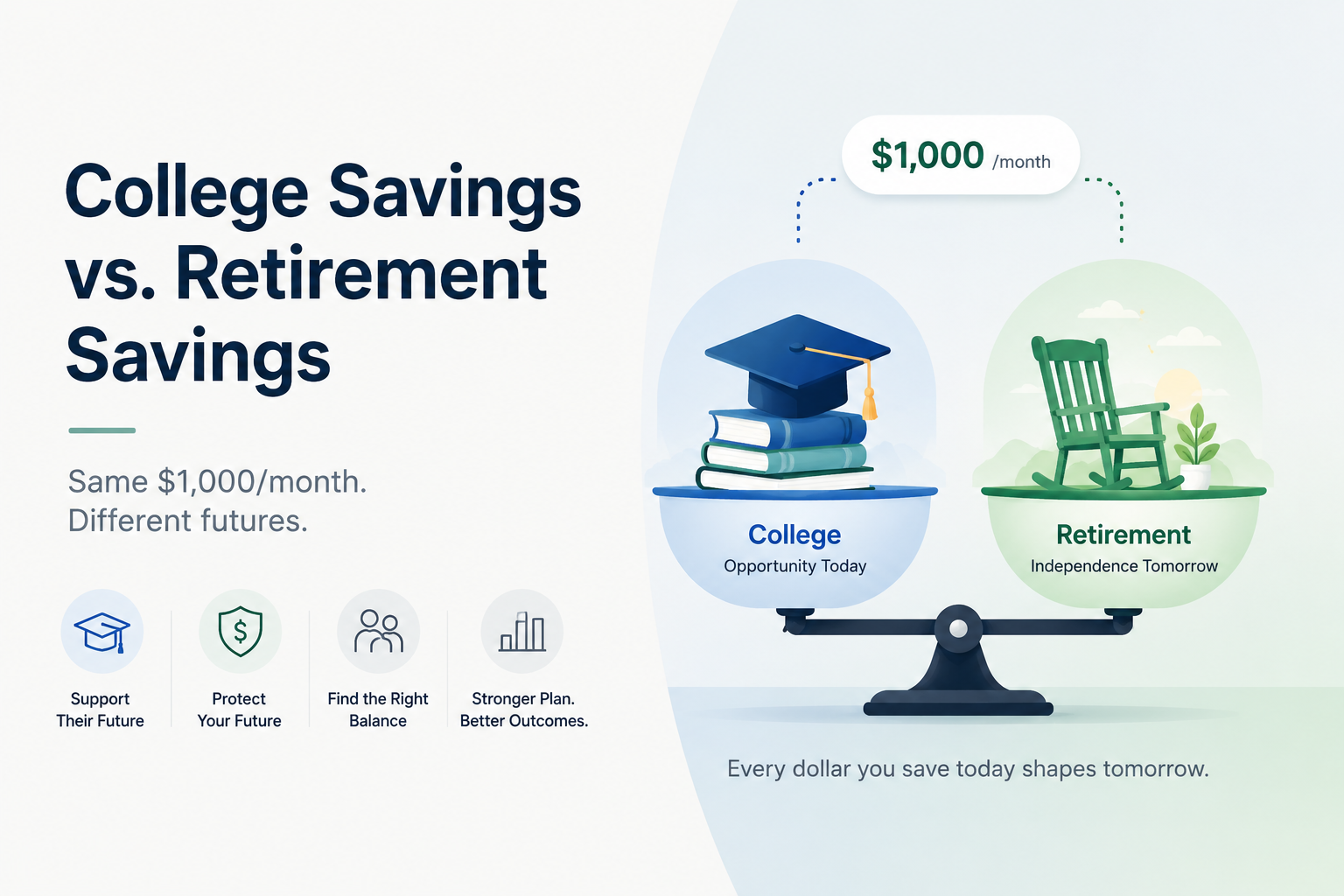
$1,000/month
Where should it go?
This is one of the hardest family money decisions because both goals matter.
Helping your child matters.
Protecting your retirement matters too.
The challenge is that every dollar saved for one goal is a dollar that cannot be saved for the other.
College and retirement are both important, but they are very different financial goals.
| College Savings | Retirement Savings |
|---|---|
| Shorter timeline | Longer timeline |
| Emotionally driven | Security driven |
| Often tied to children | Tied to future independence |
| Loans may be available | Retirement loans are not available |
| Usually lasts around 4 years | May need to last 30+ years |
That last point matters most.
College may last a few years.
Retirement may last decades.
There is a common saying in financial planning:
You can borrow for college. You cannot borrow for retirement.
That does not mean college savings should be ignored.
But it does mean parents should be careful about sacrificing retirement security to pay for college.
If saving for college causes you to fall behind on retirement, the long-term cost may be larger than expected.
Most families fall into one of three strategies.
| Priority | Result |
|---|---|
| College savings | High |
| Retirement savings | Lower |
| Main benefit | More college support |
| Main risk | Retirement shortfall |
This path may feel generous, but it can be risky if parents are already behind on retirement.
| Priority | Result |
|---|---|
| College savings | Lower |
| Retirement savings | High |
| Main benefit | Stronger future independence |
| Main risk | Child may need loans or scholarships |
This path protects retirement first, but may require the child to share more responsibility for college costs.
| Priority | Result |
|---|---|
| College savings | Moderate |
| Retirement savings | Moderate |
| Main benefit | Supports both goals |
| Main risk | Requires discipline and tradeoffs |
This is often the most realistic strategy for many families.
Suppose a household can save:
$1,000/month
Here are three possible ways to divide it.
| Strategy | College Savings | Retirement Savings |
|---|---|---|
| College First | $800 | $200 |
| Balanced | $500 | $500 |
| Retirement First | $200 | $800 |
Each path creates a different future.
The right answer depends on whether you are already on track for retirement.
Same $1,000/month. Three different futures.
Monthly Savings
| Category | Amount |
|---|---|
| College | $800 |
| Retirement | $200 |
Best for
Families who want to maximize college support and are already on track for retirement.
Monthly Savings
| Category | Amount |
|---|---|
| College | $500 |
| Retirement | $500 |
Best for
Families trying to make steady progress toward both goals.
Monthly Savings
| Category | Amount |
|---|---|
| College | $200 |
| Retirement | $800 |
Best for
Families who need to strengthen retirement savings before increasing college contributions.
Key takeaway: There isn't one correct answer. The best split depends on your retirement readiness, your child's timeline, and your overall financial goals.
Retirement should usually be prioritized if:
Protecting retirement is not selfish.
It can prevent your children from needing to support you later.
College savings may be reasonable when:
For many families, college savings works best after the retirement foundation is already in place.
A helpful order of operations may look like this:
This is not a strict rule for every family.
But it helps avoid a common mistake: funding college while the retirement plan is still fragile.
One of the biggest myths is:
Good parents pay for all of college.
A better version may be:
Good parents help in a way that does not put the entire family’s future at risk.
Helping your child matters.
But becoming financially dependent on your child later may create a bigger burden than student loans would have.
Before choosing a savings split, ask:
The right answer becomes clearer when you compare the actual tradeoffs.
College savings vs retirement savings is not a simple yes-or-no decision.
It is a scenario.
With Nestly Lab, you can compare:
AI then ranks each path based on retirement income, success probability, portfolio longevity, and long-term sustainability.
Because the best family money plan does not just fund one goal.
It protects the future of the whole family.
Many parents want to support adult children, but financial help can affect retirement timing, portfolio longevity, and future independence. Learn how to evaluate the tradeoff.
Many adults are helping aging parents and adult children while trying to prepare for retirement. Learn how family support can affect retirement readiness and how to manage the tradeoffs.
Wondering how much net worth you need to retire? Learn why there is no single magic number and how spending, income sources, timing, and healthcare shape retirement readiness.
