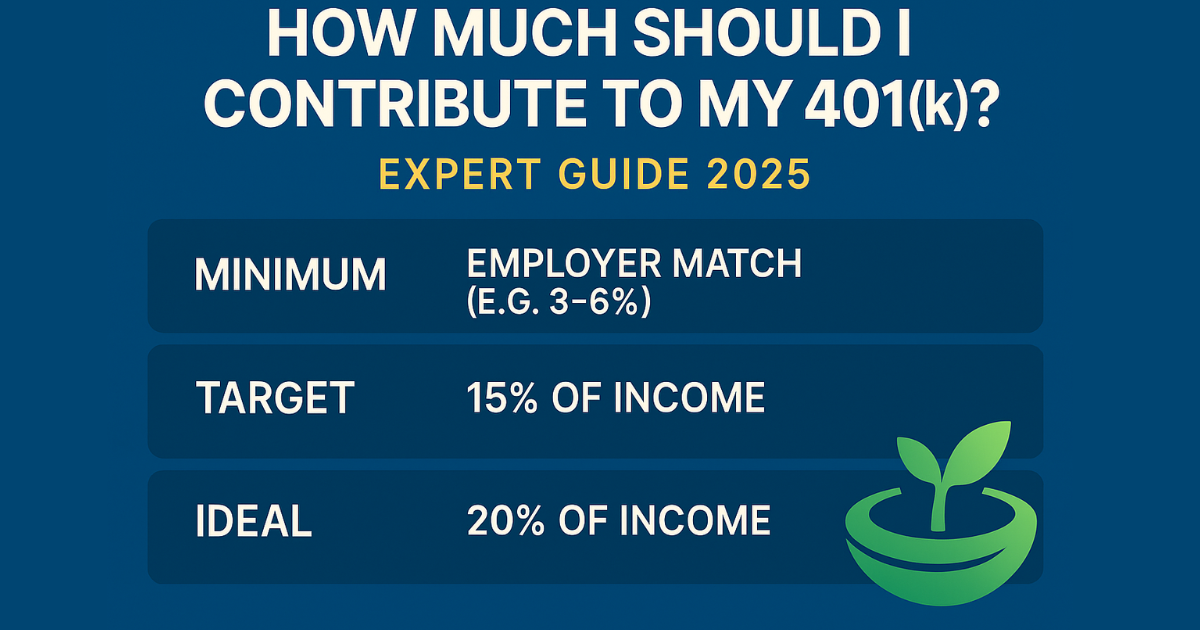
"How much should I contribute to my 401(k)?" is one of the most common questions in personal finance. The answer depends on your age, income, goals, and current financial situation.
This comprehensive guide will help you find your optimal contribution rate.
The Quick Answer (TL;DR)
Minimum: Contribute enough to get full employer match (usually 3-6%) Good: 10-15% of gross income including employer match Great: 15-20% of gross income Maximum: $23,500 in 2025 ($31,000 if 50+)
Now let's dive into the details.
1. Always Capture the Full Employer Match
This is free money you're leaving on the table if you don't take it.
Common Employer Match Formulas
50% match up to 6%: Contribute at least 6% to get 3% match
100% match up to 3%: Contribute at least 3% to get 3% match
Dollar-for-dollar up to 5%: Contribute at least 5% to get 5% match
Real Example
Your salary: $80,000
Employer offers: 50% match up to 6%
You contribute: 6% = $4,800
Employer adds: $2,400
Total savings: $7,200 (9% of salary)
Not taking the match is like declining a 50% raise on your contribution.
2. Contribution by Age (Rule of Thumb)
Here's a general guideline for total retirement savings rate (including employer match):
Age Range
Recommended Rate
Why
20s
10-15%
Time is your biggest asset - compound growth
30s
15-20%
Career growth, maximize compound interest
40s
20-25%
Catch-up time, peak earning years
50+
25-30%
Utilize catch-up contributions, final push
The "Start Young" Advantage
Starting at 25 vs 35:
Monthly contribution: $500
Annual return: 7%
Retirement age: 65
Start at 25: $1.2 million Start at 35: $566,000
That 10-year delay costs you $634,000 — more than doubling your result by starting early.
3. The 15% Total Savings Rule
Many financial advisors recommend saving 15% of gross income for retirement (including employer match).
Example Breakdown
Your salary: $70,000
Target savings: 15% = $10,500/year
Employer match: 4% = $2,800/year
Your contribution needed: 11% = $7,700/year
Why 15%?
Historical data suggests 15% sustained over 30+ years allows you to retire with similar lifestyle
Accounts for Social Security supplementing (but not relying on it)
Provides cushion for market downturns
4. Balancing 401(k) vs Other Goals
Contributing to 401(k) is crucial, but not the only financial priority.
Enter your current situation (age, salary, balance)
Set your retirement goals (age, lifestyle)
Test different contribution rates (10%, 15%, 20%)
See your projected outcome (Monte Carlo simulation)
Find your optimal number (balance goals vs current budget)
Quick Calculator Formula
Rough estimate for retirement readiness:
Target retirement savings = Current age × Current salary ÷ 2
Examples:
Age 30, Salary $60,000: Should have $30,000 saved
Age 40, Salary $80,000: Should have $40,000 saved
Age 50, Salary $100,000: Should have $50,000 saved
Behind? Increase contributions to catch up.
Action Steps: Start Today
Log into your 401(k) account — Check current contribution rate
Verify employer match — Make sure you're getting it all
Calculate 15% of salary — Set this as your target
Increase gradually — Up 1-2% now, 1% annually
Automate increases — Set it and forget it
Review annually — Adjust with raises/life changes
The Bottom Line
Minimum: Employer match (usually 3-6%) Target: 15% total savings (you + employer) Ideal: 20%+ if you can afford it Maximum: $23,500 ($31,000 if 50+)
Remember: The perfect contribution rate is the one you can sustain. It's better to contribute 10% consistently than to contribute 20% and have to stop.
Start where you are, use what you have, do what you can.
401(k) Contribution Limits for 2026: IRS Updates Explained
The IRS has officially released 401(k) and IRA contribution limits for 2026. Learn the new limits, catch-up rules, and how Nestly’s Contribution Co-Pilot helps you optimize savings.
NA
Nestly Advisor
3 min read
Read & Try
Retirement Planning
8 months ago
5 Smart Ways to Maximize Your Retirement Savings in 2026
Discover proven strategies to boost your retirement savings in 2026, including higher IRS contribution limits, employer match optimization, and smart planning with Nestly.
NT
Nestly Team
4 min read
Read & Try
Retirement Planning
about 2 months ago
The Social Security Mistake That Could Cost Married Couples Over $100,000
Many couples claim Social Security at the same age without realizing it may reduce lifetime benefits. Learn how coordinated claiming strategies can improve retirement income and long-term financial outcomes.