4 min read • 8 months ago
This article has a ready-to-run scenario — apply it to your own plan in one tap.
The IRS has introduced meaningful increases to retirement contribution limits for 2026, and SECURE 2.0 has expanded catch-up opportunities for older workers.
These changes create a rare window to accelerate retirement savings faster than in previous years—especially if you act early.
Whether you’re just starting out or nearing retirement, optimizing your strategy in 2026 can have a long-lasting impact.
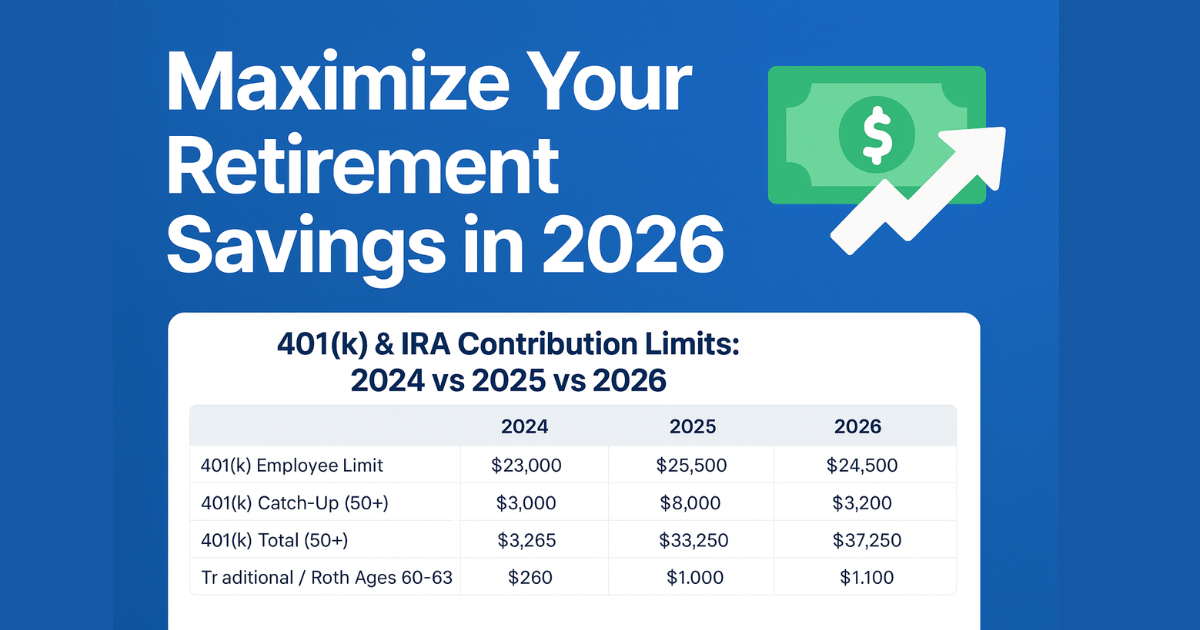
| Contribution Type | 2024 | 2025 | 2026 |
|---|---|---|---|
| 401(k) Employee Limit | $23,000 | $23,500 | $24,500 |
| 401(k) Catch-Up (50+) | $7,500 | $7,500 | $8,000 |
| 401(k) Total (50+) | $30,500 | $31,000 | $32,500 |
| Special Catch-Up (Ages 60–63) | — | — | Up to $11,250* |
| Traditional / Roth IRA Limit | $7,000 | $7,000 | $7,500 |
| IRA Catch-Up (50+) | $1,000 | $1,000 | $1,100 |
Why this matters:
2026 introduces the largest jump in retirement contribution capacity in years. Failing to update your plan means leaving tax-advantaged dollars—and potential compound growth—on the table.
* Special catch-up contributions for ages 60–63 are available under SECURE 2.0 if your employer plan allows them.
For 2026, the standard 401(k) contribution limit is $24,500. If you’re 50 or older, you can contribute an additional $8,000, for a total of $32,500.
If you’re between ages 60–63, you may be eligible for an even higher catch-up contribution of up to $11,250, depending on your plan.
Nestly Tip:
Use Nestly’s Contribution Co-Pilot to automatically step up contributions as you become eligible—without risking over-contribution.
Employer matching contributions are one of the highest guaranteed returns available.
That’s an instant 50% return before market growth.
Yet millions of workers still don’t capture their full match.
Nestly factors employer match directly into your projections so you can see its long-term impact—not just the headline number.
Roth 401(k) contributions are made with after-tax dollars, but qualified withdrawals in retirement are tax-free.
A $10,000 Roth contribution growing at 7% for 30 years becomes $76,000+, with zero taxes owed on withdrawals.
Many investors use a Traditional + Roth mix to hedge future tax uncertainty—something Nestly helps visualize inside your plan.
The easiest way to save more is to remove decision-making.
With Nestly, you can:
Automation turns good intentions into real progress.
Saving more is critical—but how your money is invested matters just as much.
Your ideal mix depends on:
Nestly helps you understand how allocation decisions affect retirement income, not just account balances.
Nestly goes beyond basic calculators by helping you:
Instead of guessing, you can see how small changes today reshape your future.
Try the Retirement Calculator →
✅ Increase contributions to reflect higher IRS limits
✅ Capture 100% of employer match
✅ Use Roth contributions for tax diversification
✅ Automate annual contribution increases
✅ Align investments with your retirement timeline
The best retirement strategy isn’t complicated—it’s consistent, intentional, and adaptive.
The changes in 2026 make it easier than ever to save more and plan smarter.
The best time to start was years ago.
The second best time is now.
See the impact of a small, easy contribution increase on your long-term plan.
See the impact of stretching your contribution rate further to maximize savings.
Retirement planning is entering a critical window. Learn why decisions made in 2025–2026—from contribution limits to AI-powered planning—can shape your financial future for decades.
Compare investing more for retirement with paying off your mortgage early. See how interest rates, employer matches, taxes, retirement timing, and risk can change the answer.
See estimated 401(k) balances by spending level, understand what changes the number, and compare retirement strategies with Nestly Lab.
