7 min read • about 18 hours ago
Retirement does not always begin when Social Security begins.
Many people want to retire at 60, 62, or 65.
But Social Security may start later.
That creates a gap.
For example:
| Age | Event |
|---|---|
| 60 | Retire |
| 67 | Full retirement age |
| 70 | Maximum delayed Social Security benefit |
If you retire at 60 and wait until 67 to claim Social Security, you need to fund seven years of expenses.
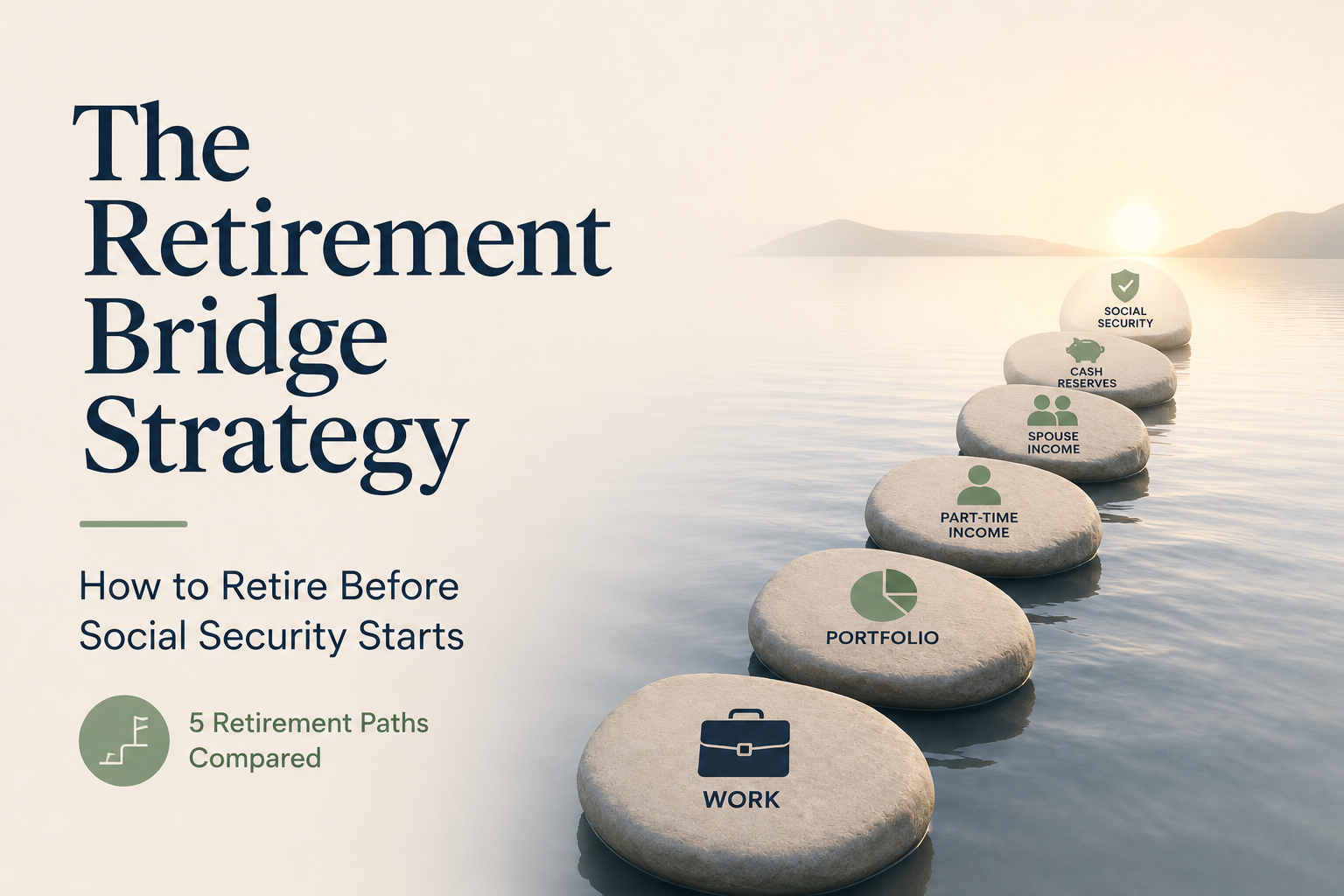
That period is the retirement bridge.
The question is simple:
Where does your income come from before Social Security starts?
A retirement bridge is the strategy used to cover spending between the day you stop working and the day long-term income begins.
That income may come from:
The bridge is temporary.
Its purpose is to help you reach the point where guaranteed or recurring income begins.
Many people ask:
Do I have enough saved to retire?
But a better question is:
How will I fund the first few years of retirement?
Those early years matter because they often come before:
If the bridge is weak, a retirement plan can become stressed before long-term income even begins.
Most early retirees should not rely on one source of income.
A stronger bridge often combines several sources.
Instead of withdrawing the full amount from investments, a household may use a mix of portfolio withdrawals, part-time income, cash reserves, rental income, and spouse income.
| Monthly Need | Portfolio Withdrawal | Other Income |
|---|---|---|
| $8,000 | $8,000 | $0 |
This creates high pressure on the portfolio.
| Source | Monthly Income |
|---|---|
| Part-time work | $2,000 |
| Cash reserve | $1,000 |
| Rental income | $1,500 |
| Portfolio withdrawals | $3,500 |
| Total | $8,000 |
The same $8,000 monthly need is covered.
But the portfolio only provides $3,500.
That difference can meaningfully improve retirement flexibility.
| Strategy | Monthly Portfolio Withdrawal | Main Benefit | Main Risk |
|---|---|---|---|
| Portfolio only | $8,000 | Simple | Highest portfolio stress |
| Portfolio plus early Social Security | $6,000 | Less early withdrawal pressure | Lower lifetime benefit |
| Part-time bridge | $4,000–$6,000 | Flexible income support | Requires continued work |
| Working spouse bridge | Lower | Income and possible healthcare coverage | Depends on spouse employment |
| Combination bridge | Lowest | Strongest flexibility | Requires coordination |
The strongest strategy is often not the most obvious one.
It is usually the one that uses multiple income sources together.
A retirement bridge is not static.
It can evolve year by year.
| Age | Possible Income Mix |
|---|---|
| 60 | Portfolio withdrawals, cash reserve, part-time work |
| 62 | Portfolio withdrawals, part-time work, possible Social Security |
| 65 | Medicare begins, healthcare costs may change |
| 67 | Full retirement age Social Security option |
| 70 | Maximum delayed Social Security benefit |
The goal is to avoid putting too much pressure on the portfolio before other income sources begin.
The later you claim Social Security, the longer your bridge must last.
| Claiming Age | Bridge Years If Retiring at 60 | Benefit Tradeoff |
|---|---|---|
| 62 | 2 years | Lower monthly benefit |
| 67 | 7 years | Higher monthly benefit |
| 70 | 10 years | Highest monthly benefit |
Claiming earlier can reduce portfolio withdrawals today.
Delaying can increase guaranteed income later.
The right answer depends on your full retirement picture.
| Factor | Assumption |
|---|---|
| Retire | 60 |
| Claim Social Security | 62 |
| Bridge Length | 2 years |
| Portfolio Stress | Lower early pressure |
| Tradeoff | Lower future Social Security |
This path may work for households that need income sooner.
| Factor | Assumption |
|---|---|
| Retire | 60 |
| Claim Social Security | 67 |
| Bridge Length | 7 years |
| Portfolio Stress | Moderate |
| Tradeoff | Requires stronger bridge assets |
This is often a balanced approach.
| Factor | Assumption |
|---|---|
| Retire | 60 |
| Claim Social Security | 70 |
| Bridge Length | 10 years |
| Portfolio Stress | Highest |
| Tradeoff | Larger guaranteed income later |
This can be powerful, but only if the bridge is strong enough.
| Factor | Assumption |
|---|---|
| Retire | 60 |
| Part-time income | $2,000/month |
| Social Security | Claim later |
| Portfolio Stress | Reduced |
| Flexibility | High |
Even modest income can lower withdrawals and extend portfolio life.
| Factor | Assumption |
|---|---|
| One spouse retires | 60 |
| Other spouse works | Until 65 or later |
| Income | Continues |
| Healthcare | Potentially covered |
| Portfolio Stress | Lower |
This can be one of the strongest bridge strategies because it may provide income and health insurance before Medicare.
The biggest mistake is thinking the only question is:
How much do I need to withdraw?
The better question is:
How many income sources can work together to reduce withdrawals?
That shift changes retirement planning.
Instead of relying only on portfolio withdrawals, the bridge becomes a coordinated system.
Nestly Lab helps you compare multiple retirement bridge strategies side by side.
You can test:
AI then ranks each path based on retirement income, portfolio longevity, success probability, and long-term sustainability.
Because the goal is not simply to retire before Social Security starts.
It is to build the strongest bridge between work and long-term retirement income.
Many couples don't retire at the same time. Learn how one spouse continuing to work can improve healthcare coverage, reduce portfolio withdrawals, and create a stronger retirement plan.
One million dollars can last very different lengths of time depending on spending, Social Security, healthcare, and retirement age. Compare common scenarios and see what really drives retirement longevity.
Many retirees focus on how much they've saved, but the real question is how much they can safely spend. Learn how to evaluate retirement spending strategies and understand the tradeoffs.
