4 min read • about 2 months ago
This article has a ready-to-run scenario — apply it to your own plan in one tap.
Many married couples make a simple Social Security plan:
Primary: claim at 67.
Spouse: claim at 67.
It feels logical.
But for some households, claiming at the same age may leave meaningful income on the table.
The better question is not:
When should each person claim?
The better question is:
What claiming strategy creates the strongest household income plan?
Social Security is often treated like an individual benefit.
For married couples, it is usually a household strategy.
Claiming decisions can affect:
The highest benefit for one person does not always create the best outcome for the couple.
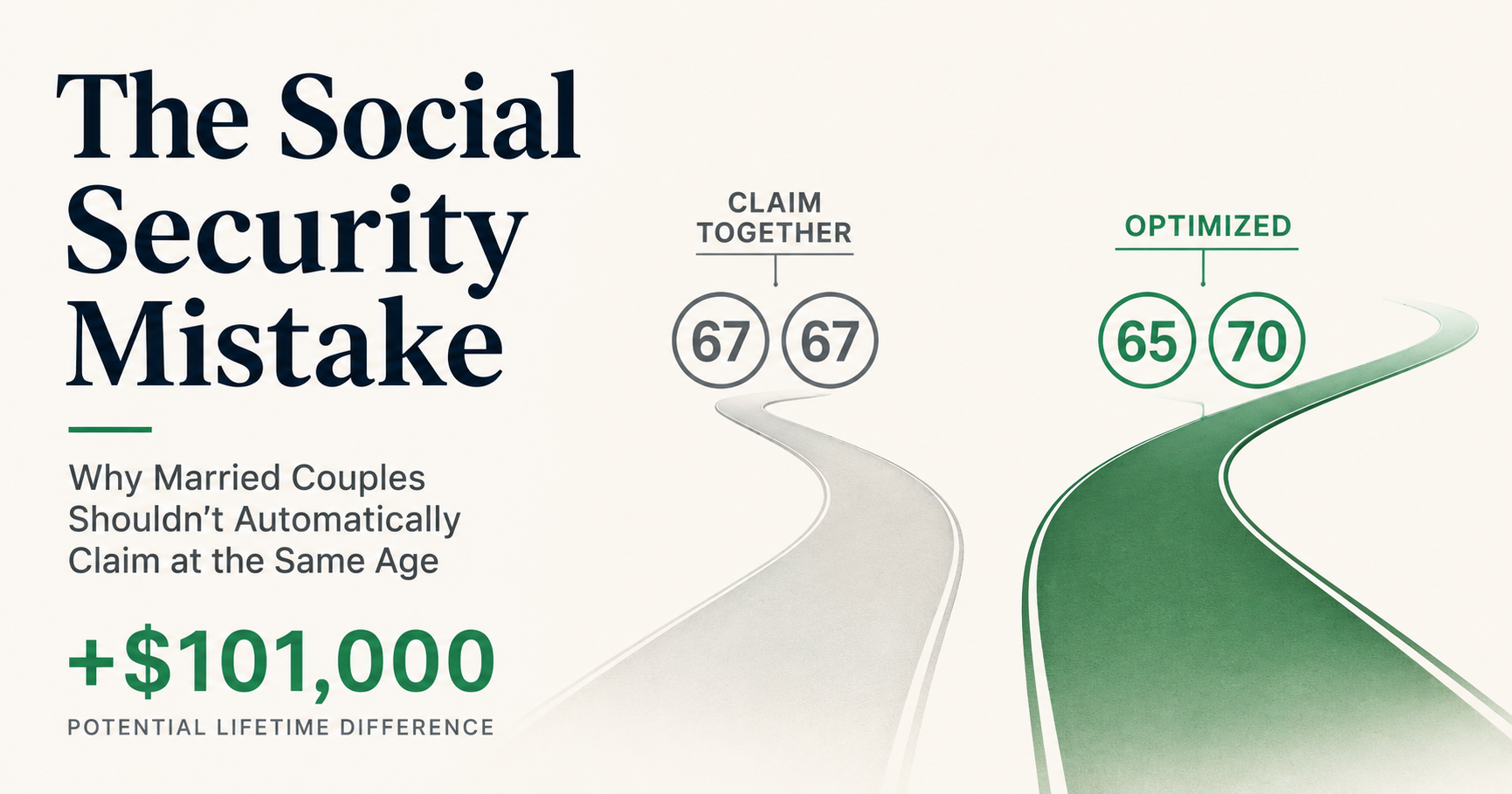
A couple may start with this plan:
Primary: claim at 67.
Spouse: claim at 67.
After testing different options, a better strategy may be:
Primary: claim at 65.
Spouse: claim at 70.
That may sound surprising.
But one spouse claiming earlier can help cover near-term income needs, while the other spouse delaying can increase future guaranteed income.
Many couples assume both spouses should claim Social Security at the same age.
Often, that is not the best strategy.
When one spouse claims earlier and the other delays benefits, the household may receive:
Current Strategy:
Primary: claim at 67.
Spouse: claim at 67.
Optimized Strategy:
Primary: claim at 65.
Spouse: claim at 70.
Potential Impact:
Monthly Income: +$2,800/month
Coverage: 79% → 105%
Lifetime Benefit: +$101,000+
The goal is not to maximize one person's benefit.
The goal is to maximize the household's retirement income.
A coordinated strategy can help in three simple ways.
If one spouse claims earlier, that income may help cover spending needs in the first years of retirement.
That can reduce the amount withdrawn from savings.
If one spouse delays benefits, that benefit may be larger later in retirement.
That can help protect the household if retirement lasts longer than expected.
If the higher benefit is delayed, the surviving spouse may have a stronger income base later.
That can matter a lot if one spouse outlives the other by many years.
The biggest mistake is not always claiming too early.
It is not always claiming too late.
The biggest mistake is never comparing options.
Many households never test:
Without comparing strategies, it is hard to know which option actually improves the plan.
Before deciding when to claim, ask:
These questions are more useful than simply choosing a popular claiming age.
Nestly's Social Security Optimization engine compares different claiming strategies and shows how each one affects your retirement plan.
Using Nestly Studio, you can compare:
For couples, Nestly can identify strategies where one spouse claims earlier while the other delays benefits to create a more efficient household income plan.
Because retirement planning is not just about maximizing benefits.
It is about building reliable income for the life you want.
See the real lifetime income lift from delaying Social Security to 70 instead of claiming early.
Should you collect Social Security at 62, your Full Retirement Age, or wait until 70? Compare estimated benefits, learn how to find your personalized estimate, and discover which claiming strategy may fit your retirement plan.
See estimated 401(k) balances by spending level, understand what changes the number, and compare retirement strategies with Nestly Lab.
One million dollars may be enough for retirement—or fall short—depending on your spending, retirement age, Social Security, healthcare, taxes, and market conditions.
