11 min read • Published 3 months ago • Updated Aug 10, 2026
Understanding what an RMD is is only the first step.
The next challenge is figuring out how the rules actually work once Required Minimum Distributions begin.
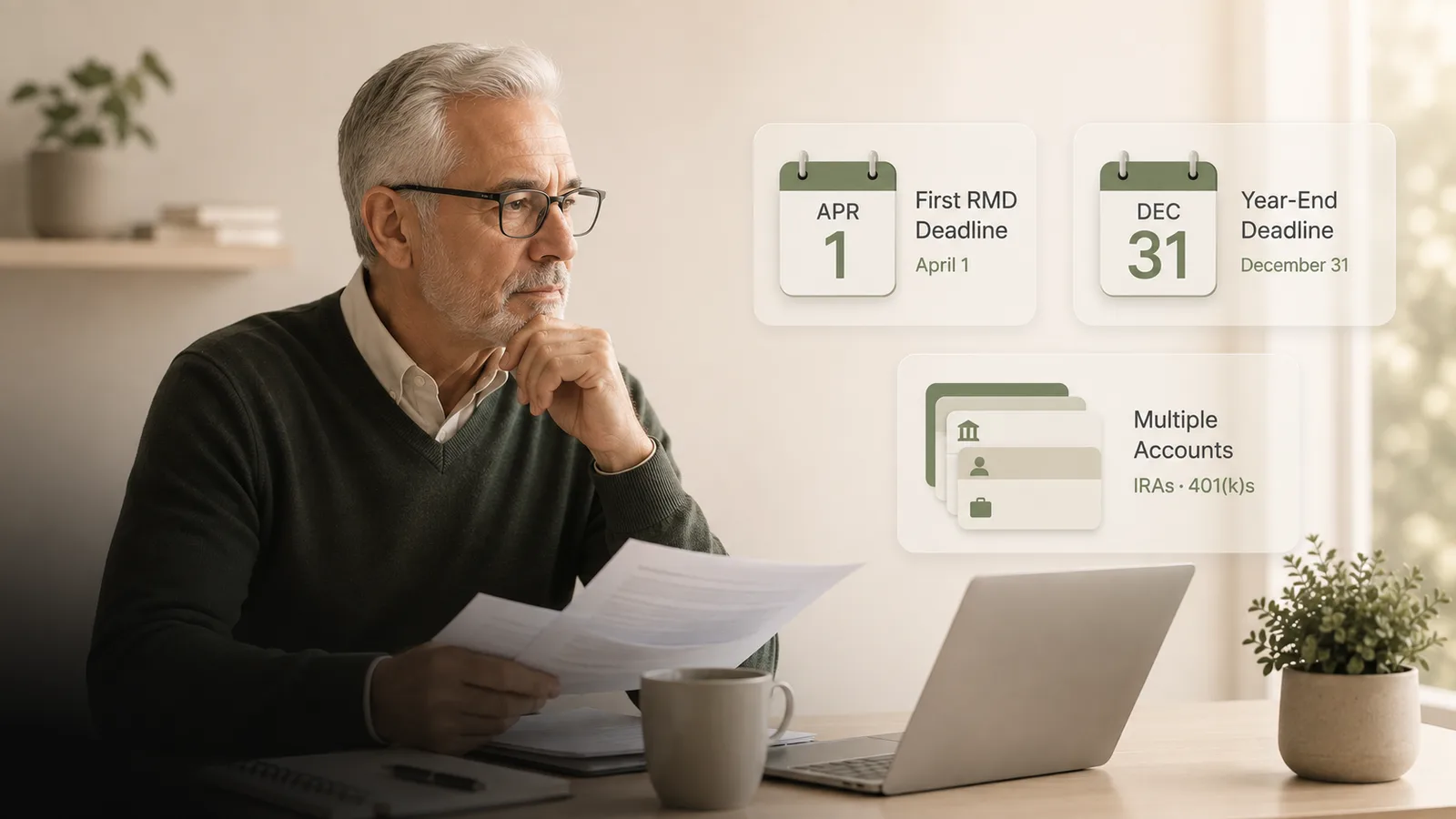
Your first RMD can have a different deadline from later years.
Multiple IRAs may be handled differently from multiple 401(k)s.
And you may still have choices about what to do with the money after it leaves the retirement account.
This article walks through those rules with simple examples.
Your first RMD can be slightly confusing because the deadline works differently from later years.
For many retirees, the first RMD is generally due by April 1 of the year after the year you reach your applicable RMD age.
After that, future RMDs are generally due by December 31 each year.
That creates an important choice.
You can take the first RMD during the year you reach RMD age.
Or you may be able to delay it until the following April.
The catch is that delaying the first RMD can create two RMDs in the same calendar year:
That can increase taxable income for that year.
Suppose Robert reaches his applicable RMD age in 2035.
His first RMD is approximately:
$45,000
He could take it during 2035.
Or he may be able to wait until April 1, 2036.
Now suppose his second RMD is:
$47,000
If he delays the first distribution, he could potentially have:
$45,000 + $47,000 = $92,000
of RMDs during 2036.
That does not automatically mean delaying the first RMD is wrong.
It means the timing deserves attention.
An RMD from a traditional retirement account is generally taxable income, except for any applicable non-taxable basis or other exceptions.
So taking two distributions in one calendar year can mean more taxable income during that year.
That may interact with:
You do not need to become a tax expert before taking your first RMD.
But you should understand the timing before automatically delaying it.
Many retirees have several traditional IRAs.
For example:
You generally calculate the RMD for each IRA separately.
But in many cases, you may be able to combine the IRA RMD amounts and withdraw the total from one or more of your IRAs.
| Account | Calculated RMD |
|---|---|
| Traditional IRA #1 | $12,000 |
| Traditional IRA #2 | $8,000 |
| Rollover IRA | $10,000 |
| Total IRA RMD | $30,000 |
You may be able to satisfy the full $30,000 requirement from one IRA.
Or you could divide it across several IRAs.
The key point is that the total IRA requirement still needs to be satisfied.
Employer retirement plans can work differently.
Suppose you have:
Do not assume those RMDs can automatically be combined the same way IRA RMDs sometimes can.
Each employer plan may have its own RMD requirement and distribution process.
That may mean taking separate distributions from different plans.
Some retirees simplify their accounts before RMDs begin.
Fewer accounts can make it easier to:
But consolidation is not automatically better.
Rolling an old 401(k) into an IRA or another employer plan can affect:
Do not consolidate accounts only because the RMD paperwork looks easier.
Look at the entire retirement plan.
Missing a required distribution can create an excise tax on the amount that should have been withdrawn.
Rules and available relief can change.
The practical lesson is simple:
Do not wait until December to discover whether you have an RMD.
Before your first required distribution, know:
Not always.
Depending on your custodian and account, you may sometimes be able to distribute investments directly from the retirement account into a taxable brokerage account.
This is often called an in-kind distribution.
For example, instead of selling shares inside your IRA and withdrawing cash, you may be able to transfer shares with the required value into a taxable account.
The fair value of the transferred assets generally counts toward the distribution amount.
But this does not make the distribution tax-free.
The RMD is still a distribution from the tax-deferred account.
The difference is simply that you may not have to sell the investment first.
Yes, after the required distribution has left the retirement account.
Suppose Robert's RMD is:
$50,000
But he only needs:
$30,000
for spending.
That leaves:
$20,000
Robert may choose to save or invest that money in a taxable brokerage account.
So an RMD does not mean:
"You must spend this money."
It means:
"This amount must leave the tax-deferred retirement account."
What you do with the money afterward is a separate decision.
You generally cannot directly roll an RMD into another retirement account.
The required distribution must first be satisfied.
That becomes important when Roth conversions enter the conversation.
You cannot simply take the amount you were already required to distribute and call it a Roth conversion instead.
The RMD and a Roth conversion are separate transactions.
We will cover that distinction later in this series.
Your personalized projection
See what your retirement could look like.
Get an instant estimate of your portfolio at retirement, sustainable monthly income, retirement timeline, and readiness score.
Describe your future.
Tell Nestly about your finances, goals, or future plans in plain English.
Your annual RMD depends mainly on:
As you get older, the IRS distribution factor generally becomes smaller.
That means the percentage required to come out of the account generally rises.
At the same time, the remaining retirement account may continue growing.
Those two forces can produce larger RMDs later in retirement.
Using age 75 as a simple illustration:
| Traditional Retirement Balance | Approximate RMD |
|---|---|
| $500,000 | $20,325 |
| $1,000,000 | $40,650 |
| $1,500,000 | $60,976 |
| $2,000,000 | $81,301 |
Someone with a $500,000 traditional balance may face a very different required withdrawal than someone with $2 million.
That is why account size matters.
It is also why looking ahead before RMDs begin can be useful.
This happens frequently.
Imagine Robert's normal annual spending is already covered by:
Then an $80,000 RMD could create income he did not actually need for spending.
He still receives the money.
But it may create additional taxable income.
That is where RMDs begin turning from a distribution rule into a retirement tax-planning issue.
You generally need to withdraw it.
You do not need to spend all of it.
Delaying your first RMD may cause two distributions to occur in the next calendar year.
Know the timing before deciding.
Traditional IRAs, 401(k)s, other employer plans, and Roth accounts can have different rules.
Generally, it does not.
Each year's RMD is calculated separately.
Traditional-account RMDs are generally taxable income except for any applicable non-taxable basis or other exceptions.
You may have more planning flexibility years before RMDs begin.
Understanding your projected future distributions earlier gives you more time to compare options.
Before RMDs begin, make sure you know:
A little preparation can make the process much simpler.
Suppose Robert is only 65 today.
He has:
$1.2 million
in traditional retirement accounts.
His RMDs have not begun.
It might be easy to ignore them.
But his account could continue growing for years.
Waiting until the first required withdrawal arrives may leave him asking:
Could I have planned this differently?
The years before RMDs begin may provide more flexibility over:
That leads directly into the next article.
Understanding how RMDs work is important.
But the bigger question is:
Why does the size of an RMD matter?
Imagine Robert eventually receives:
Those income sources begin stacking together.
That can change his taxable income in retirement.
And that is where RMD planning becomes tax planning.
The next article will show how RMDs can combine with:
We will compare smaller, moderate, and larger RMDs and show why taxable income can change significantly later in retirement.
After that:
We will compare:
No conversion
vs.
Moderate annual conversions
vs.
Larger conversions
and look at taxes today, future RMDs, Roth balances, and projected lifetime taxes.
Your first RMD is not something to fear.
It is something to plan for.
Know the amount.
Know the deadline.
Know which account will fund it.
And most importantly, understand how that required income fits into the rest of your retirement.
Important Disclaimer: This article is for educational purposes only and is not individualized tax, investment, legal, or retirement advice. RMD rules depend on account type, birth year, beneficiary status, employment status, and current tax law. Rules can change. Verify current IRS requirements and consider qualified tax or financial professionals before making retirement-account decisions.
Start from your current plan, change one assumption from the article, and save the version only if it is worth comparing later.
How we make these. Articles are produced by the Nestly Editorial Team. We use AI for formatting and proofreading, and to create article images. Every Read & Try scenario runs on the Nestly Lab What-If Engine, powered by Nestly Horizon, our proprietary projection and calculator engine, so you can test it with your own numbers.

Two retirees can both have $2 million and still have very different amounts available to spend. See why Traditional, Roth, and taxable account balances matter in retirement.

Learn what required minimum distributions are, when they start, how they are calculated, and what different retirement account balances could mean for your future withdrawals.

See estimated 401(k) balances by spending level, understand what changes the number, and compare retirement strategies with Nestly Lab.
