
12 min read • Published 3 months ago • Updated Aug 6, 2026
Load all 3 article strategies with your numbers before you decide.
Maybe.
Downsizing can lower expenses, unlock home equity, and make retirement easier to manage.
But moving also costs money.
And a smaller home does not automatically mean a cheaper retirement.
The better question is:
Will changing your home actually strengthen your retirement plan?
There are three clear paths to compare:
Karen is 59.
David is 61.
They plan to retire when David turns 63.
| Item | Amount |
|---|---|
| Current home value | $850,000 |
| Mortgage balance | $180,000 |
| Current housing costs | $3,200/month |
| Retirement investments | $1.35M |
| Annual retirement spending goal | $90,000 |
| Target retirement age | 63 |
Their home has roughly:
$850,000 − $180,000 = $670,000
of gross equity before selling costs, taxes if applicable, repairs, moving expenses, and the cost of their next home.
Their question is simple:
Should we stay, downsize, or move somewhere cheaper?
Karen and David keep their current home.
They keep paying for:
The question is not only:
Can we afford this home today?
It is:
Will we still want to pay for this home at 70 or 80?
Suppose Karen and David sell their current home and buy a smaller home for $550,000.
A simplified example:
| Step | Amount |
|---|---|
| Home sale price | $850,000 |
| Remaining mortgage | -$180,000 |
| Gross equity before costs | $670,000 |
| New home | -$550,000 |
| Remaining before transaction costs | $120,000 |
This is intentionally simplified.
Actual proceeds may be lower after:
A smaller house does not automatically mean a cheaper retirement.
Now imagine they move to a lower-cost area and buy a home for $400,000.
That may release more equity and reduce monthly costs.
But relocating changes more than housing.
It can also affect:
A cheaper home can still create a worse retirement if the location does not support the life they want.
| Stay | Downsize | Relocate | |
|---|---|---|---|
| Current / new home value | $850K | $550K | $400K |
| Moving required | No | Yes | Yes |
| Equity potentially unlocked | None | Some | More |
| Housing costs | Highest | Lower | Potentially lowest |
| Lifestyle change | Low | Medium | High |
| Community change | None | Possible | Likely |
The lowest-cost option is not automatically the best option.
Focus on four things.
Include:
Do not compare home prices alone.
How much money actually remains after:
That is the number that matters.
If downsizing lowers annual spending by $12,000, your portfolio needs to support $12,000 less each year.
That can materially change retirement readiness.
Ask:
Housing is both a financial and lifestyle decision.
Suppose downsizing reduces Karen and David's housing costs by:
$1,000 per month
That equals:
$12,000 per year
Their planned retirement spending falls from:
$90,000
to:
$78,000
That means their investments need to support less spending every year.
Unlike trying to earn higher investment returns, lower recurring expenses do not depend on market performance.
If downsizing materially lowers your future spending, test whether retiring sooner becomes realistic.
See how retiring two years sooner changes your retirement outlook after reducing future housing costs.
All article tests · No account neededOpens every article test in Lab. No account required until you save.Compare:
Suppose the total cost of selling, buying, moving, and preparing the new home is:
$50,000
And downsizing saves:
$12,000 per year
A simple break-even calculation is:
$50,000 ÷ $12,000 ≈ 4.2 years
If Karen and David expect to stay in the new home for 15 years, the move may look attractive.
If they expect to move again in three years, it may not.
This does not include appreciation, taxes, financing costs, or other variables.
It is simply a useful starting point.
Staying may be the stronger choice when:
Staying can also avoid:
If the home still fits your lifestyle and your retirement budget, there may be no reason to move just because retirement is approaching.
Downsizing may deserve stronger consideration when:
The key word is materially.
Moving from an $850,000 home to a $750,000 home may not change the retirement plan very much after transaction costs.
Moving to a $500,000 home could be a very different decision.
Relocating may make sense when:
But do not move for taxes alone.
A lower-tax area may have:
Compare the full lifestyle.
Your personalized projection
See what your retirement could look like.
Get an instant estimate of your portfolio at retirement, sustainable monthly income, retirement timeline, and readiness score.
Describe your future.
Tell Nestly about your finances, goals, or future plans in plain English.
Karen and David now compare all three options.
They keep the $850,000 home.
Their retirement spending remains close to:
$90,000 per year
They preserve their community and avoid moving costs.
But housing remains one of their largest expenses.
They move into a $550,000 home.
Suppose their annual spending falls to:
$78,000
They also unlock some home equity.
That gives their retirement plan:
They move to a lower-cost area and buy for $400,000.
Suppose annual retirement spending falls further to:
$70,000
This may create the strongest financial outcome.
But it also creates the largest lifestyle change.
They must decide whether the financial improvement is worth leaving their current community.
Housing decisions can also affect retirement resilience.
Imagine Karen and David retire and markets fall 20%.
If they stayed in their current home, they still need to support the full $90,000 annual lifestyle.
If downsizing reduced spending to $78,000, the portfolio needs to provide less.
That can matter when investments are down.
Lower fixed expenses can create more flexibility during weak markets.
See how a 20% decline in your current savings changes your retirement outlook.
See how a 20% decline in your current savings changes your retirement plan and whether lower housing costs could improve resilience.
All article tests · No account neededOpens every article test in Lab. No account required until you save.Compare:
Housing and Social Security should not be planned separately.
If Karen and David reduce housing expenses, they may have more flexibility to delay Social Security.
That could mean:
A lower-cost home can make delaying benefits easier for some households.
See how waiting until age 70 changes your retirement income.
See how waiting until age 70 to claim Social Security changes your retirement income after lowering housing costs.
All article tests · No account neededOpens every article test in Lab. No account required until you save.Compare:
A large home value can make a household feel wealthier than it really is.
But home equity does not automatically pay monthly expenses.
To use that equity, you may need to:
That is why retirement planning should separate:
Net worth
from
Spendable retirement assets
A $1 million home and a $1 million investment portfolio serve very different purposes.
Avoid these common mistakes.
The home's estimated value is not the same as the amount you will receive after selling.
Account for:
Downsizing should improve the retirement plan.
If the new home costs almost as much as the old one, the financial benefit may be small.
A condo or smaller community may have lower maintenance but higher monthly HOA costs.
Compare total housing expenses.
Taxes are one part of the decision.
Healthcare, insurance, transportation, family, and lifestyle matter too.
Keep enough liquidity for:
| If This Sounds Like You | Compare |
|---|---|
| House is affordable and you love it | Stay |
| Too much unused space | Downsize |
| Maintenance is becoming difficult | Downsize |
| Large home equity but limited investments | Downsize |
| High property taxes | Downsize or relocate |
| Expensive retirement location | Relocate |
| Family lives elsewhere | Relocate |
| Moving saves very little | Stay |
| Lower housing costs could move retirement earlier | Compare all three |
Before making a housing decision, ask:
If you cannot answer these questions, you are not ready to compare the three paths yet.
Nestly helps you compare housing decisions inside your complete retirement plan.
With Nestly Lab, you can test:
Instead of asking:
"Should we downsize?"
ask:
"Which housing path gives us the strongest retirement and the life we actually want?"
Your home does not have to remain your largest retirement expense just because it was your largest working-years purchase.
But moving is not automatically the answer either.
Compare:
Stay
Downsize
Relocate
Then choose the path that improves both your finances and your quality of life.
Important Disclaimer: This article is for educational purposes only and is not individualized investment, tax, legal, real-estate, or retirement advice. Home values, transaction costs, taxes, insurance, mortgage terms, healthcare costs, and retirement outcomes vary by household. Review your complete financial situation and consider qualified financial, tax, and real-estate professionals before making major housing or retirement decisions.
Load all 3 tests from this article against your current assumptions. If a result is useful, save it to keep comparing later.
How we make these. Articles are produced by the Nestly Editorial Team. We use AI for formatting and proofreading, and to create article images. Every Read & Try scenario runs on the Nestly Lab What-If Engine, powered by Nestly Horizon, our proprietary projection and calculator engine, so you can test it with your own numbers.

A market crash right after retirement can be more damaging than the same decline years later. Learn how sequence-of-returns risk works and how flexible spending, cash reserves, and retirement timing can help.

Estimate how much you may need invested for retirement based on spending, Social Security, retirement age, healthcare, and other income.
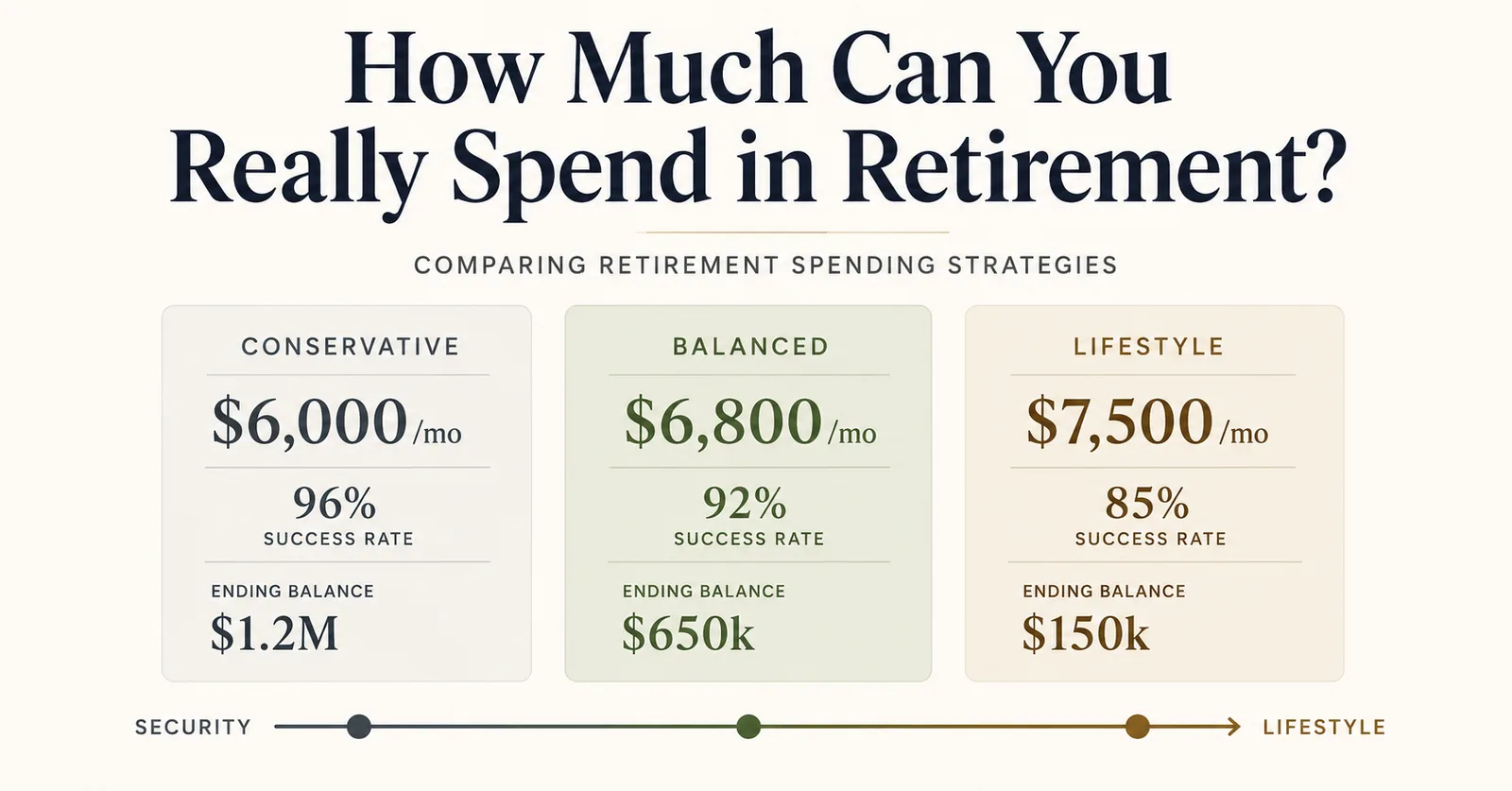
Many retirees focus on how much they've saved, but the real question is how much they can safely spend. Learn how to evaluate retirement spending strategies and understand the tradeoffs.
