Nestly icon
Nestly

Retirement Projection Suite

HomeCalculatorBlogGet Started

Why 2025–2026 Will Be a Defining Window for Retirement Planning

Retirement planning is entering a critical window. Learn why decisions made in 2025–2026—from contribution limits to AI-powered planning—can shape your financial future for decades.

Retirement Planning

4 min read • about 1 month ago

N
Nestly Team
Nestly Team
#retirement planning
#401k strategy
#financial planning
#AI finance
#Nestly Advisor

A Small Window That Can Shape Decades

Most people think of retirement planning as something gradual—something you’ll “optimize later.”
But certain moments matter more than others.

2025–2026 is one of those moments.

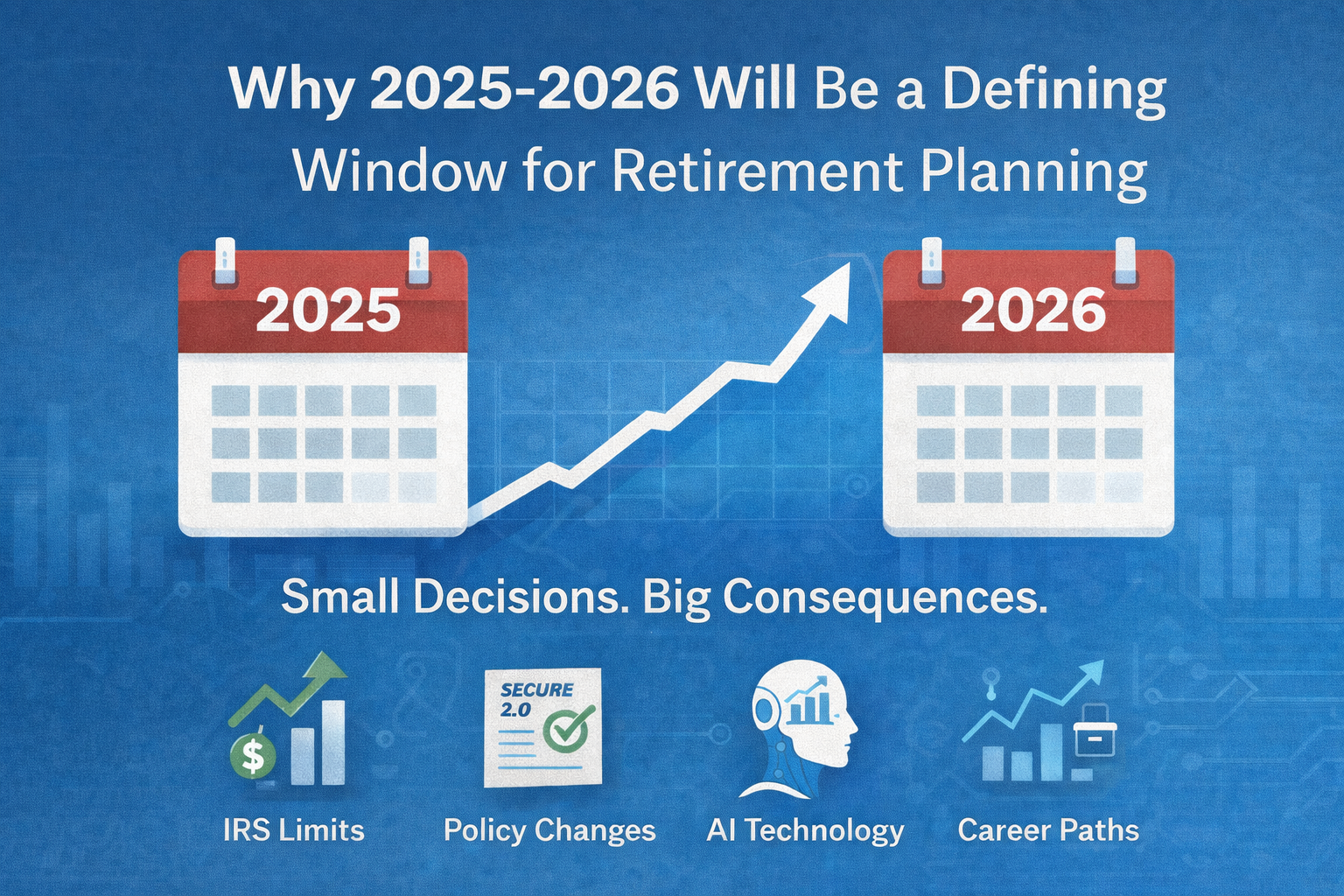
It’s a rare intersection of:

  • Rising IRS contribution limits
  • Major policy changes from SECURE 2.0
  • Rapid adoption of AI in financial planning
  • A workforce becoming less stable and more nonlinear

The choices made—or delayed—during this window can have an outsized impact on retirement outcomes over the next 20–40 years.


1. Timing Matters More Than People Realize

Retirement success isn’t just about how much you save—it’s about when decisions are made.

Two people with similar incomes can end up with dramatically different outcomes simply because one acted earlier during a high-impact period.

Why?

  • Contributions made earlier compound longer
  • Missed opportunities are difficult to recover from
  • Later “optimization” rarely offsets lost time

2025–2026 represents a leverage point where small adjustments can produce large future gains.


2. Policy Tailwinds: Higher Limits, More Flexibility

Recent IRS updates have increased retirement contribution limits, including:

  • Higher 401(k) employee limits
  • Expanded catch-up contributions
  • Greater flexibility under SECURE 2.0

These changes create real opportunity—but only for those who act on them.

The Reality

Rising limits don’t automatically improve outcomes.
They only help if:

  • Contributions are increased intentionally
  • Employer match is fully captured
  • Plans are revisited to reflect new rules

This is why awareness alone isn’t enough—execution matters.


3. Technology Shift: From Guesswork to Guided Planning

Until recently, retirement planning relied heavily on:

  • Rules of thumb
  • Static spreadsheets
  • Single “average return” assumptions

That approach no longer reflects reality.

AI-powered planning tools are changing how people:

  • Model uncertainty
  • Understand risk
  • Evaluate tradeoffs
  • Make incremental decisions with clarity

What’s Different Now

Instead of asking:

“Will I have enough?”

People can now ask:

“What’s the probability this plan works—and how can I improve it?”

The shift from certainty to probability is one of the most important advances in modern retirement planning.


4. Career Reality: Less Stability, More Planning Required

The future of work is becoming less predictable:

  • AI is reshaping roles and industries
  • Career paths are no longer linear
  • Income volatility is increasing

This makes rigid retirement assumptions risky.

Why This Matters

Plans built around:

  • A fixed retirement age
  • Predictable salary growth
  • Minimal career disruption

are increasingly unrealistic.

Flexible, adaptive plans are no longer optional—they’re essential.


5. The Real Cost of Waiting Until “Later”

One of the most common mistakes during pivotal periods like 2025–2026 is delay.

People often think:

  • “I’ll increase contributions next year”
  • “I’ll revisit this when things are more stable”
  • “I’ll optimize once I earn more”

But compounding doesn’t wait.

The Hidden Cost

Delaying even 2–3 years can:

  • Reduce final balances by hundreds of thousands
  • Require significantly higher future contributions to catch up
  • Increase stress later in life when flexibility is lower

Time remains the most powerful variable in retirement planning—and it’s the one you can’t replace.


6. What Smart Savers Are Doing Right Now

Those who take advantage of defining windows like 2025–2026 tend to:

  • Increase contributions intentionally, not reactively
  • Capture full employer match
  • Stress-test plans against uncertainty
  • Plan for longevity, not just balances
  • Review plans annually instead of “set and forget”

They don’t wait for perfect clarity—they plan through uncertainty.


7. How Nestly Helps During This Window

Nestly is built for moments like this.

Instead of relying on static assumptions, Nestly helps users:

  • Model multiple future scenarios
  • Visualize the impact of small changes
  • Understand risks like longevity and market volatility
  • Make informed decisions without emotional guesswork

The goal isn’t prediction—it’s preparation.

AI becomes a planning co-pilot, helping users navigate uncertainty with confidence and clarity.


The Bottom Line

2025–2026 isn’t just another year on the calendar.

It’s a decision window—one where:

  • Policy changes create opportunity
  • Technology enables better planning
  • Early action compounds disproportionately
  • Delay becomes more expensive

You don’t need to predict the future perfectly. You just need a plan that can adapt to it.

The best time to act isn’t “someday.”
It’s when the opportunity window is open.


Related Reading

Ready to see how decisions today shape outcomes decades from now?
Explore your retirement scenarios with Nestly and plan confidently through change.

Related Articles
Retirement Planning
2 months ago

5 Smart Ways to Maximize Your Retirement Savings in 2026

Discover proven strategies to boost your retirement savings in 2026, including higher IRS contribution limits, employer match optimization, and smart planning with Nestly.

NT
Nestly Team
4 min read
Retirement Planning
8 days ago

Buying a Car at Retirement: How to Plan Without Derailing Your 401(k)

Buying a car around retirement is common—but it can quietly strain your retirement plan. Learn how to budget, time, and fund a car purchase without hurting long-term income.

NT
Nestly Team
4 min read
Retirement Planning
15 days ago

The Average 401(k) Balance at Age 58 — And What It Means for Your Retirement

The average 401(k) balance for Americans approaching retirement may be lower than expected. Learn what this means, why the gap exists, and how tools like Nestly can help you plan smarter.

NT
Nestly Team
4 min read